
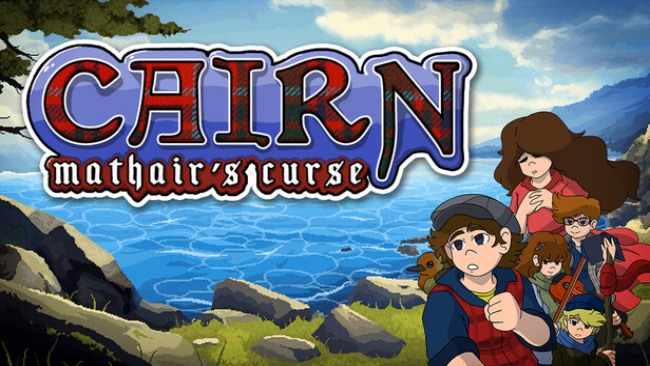
Game Overview
A small Scottish community becomes the stage for a surprisingly personal JRPG about family, grief, and the pull of old myths. Cairn: Mathair’s Curse follows a boy and his mother through a Highlands-inspired world that blends early-2000s everyday life with Celtic folklore, buried secrets, and a growing supernatural threat. Its mood shifts comfortably between heartfelt drama and absurd local humour, so a frightening legend can sit beside a battle with a roaming haggis or a deeply confused road sign. Beneath the jokes lies a story focused on loss and the ways people cope when the past refuses to stay buried.
Travel takes the party through coastal villages, underground ruins, and concealed technological facilities, with handcrafted areas designed to reward looking beyond the main route. Turn-based encounters form the backbone of the adventure, asking players to choose attacks, manage each character’s distinct abilities, and combine party skills for stronger tactical results. Enemy groups range from bizarre wildlife to apocalyptic cultists, keeping battles visually playful even when the stakes rise. Exploration also includes environmental puzzles that open new paths and lead to useful presents and optional discoveries, while the roughly 30-hour campaign gives the narrative room to develop its characters and mysteries.
Scottish identity is the clearest differentiator here: the setting is not a generic fantasy kingdom with a few borrowed names, but a recognisable rural culture reframed through myth, comedy, and JRPG adventure. The result recalls the offbeat enemy design and warm-hearted weirdness of EarthBound, while its party-based combat and extended story structure speak to classic console role-playing games. Handcrafted locations and puzzle gates give progression more texture than simply moving from one fight to the next. Fans of story-led indie RPGs, Celtic folklore, and eccentric humour should find plenty to enjoy, while genre newcomers can appreciate a focused single-player journey rather than an overwhelming open-ended epic.
Screenshots
Installation
- Select the Download button at the top of this page to open UploadHaven.
- On UploadHaven, wait for any countdown, then select Free Download. Optional: UploadHaven Pro for faster downloads.
- When complete, extract the archive to a Cairn: Mathair's Curse folder using 7-Zip.
- Open the extracted folder and start the game normally.
- For errors, check Setup Guide & Troubleshooting below. Keep your security software enabled.
System Requirements
- Requires a 64-bit processor and operating system
- OS *: Microsoft Windows 7-64 bit or later
- Processor: Intel Pentium III 800 MHz
- Memory: 2 GB RAM
- Graphics: DirectX 9/OpenGL 4.1 capable GPU
- Storage: 1 GB available space
- Sound Card: DirectSound-compatible sound card
Setup Guide & Troubleshooting
How do I fix missing DLL errors for Cairn: Mathair’s Curse?
After extracting Cairn: Mathair’s Curse, navigate to the _Redist or _CommonRedist folder inside the game directory and install DirectX, Vcredist, and any other dependencies included.
What should I do if the downloaded file is corrupted?
The full archive is 0.95 GB — make sure your download completed fully before extracting. Use 7-Zip to extract the files. If you still see a "file corrupted" error, re-download and try again.
Do I need to run the game as administrator?
Usually, no. Start the game normally from the extracted folder. If you see a permissions or save error, check that the folder is writable and follow the game's documented fix. Only grant administrator access when a trusted game's specific setup requires it.
How do I update my GPU drivers for this game?
The game won't launch — what should I try?
Check that extraction completed and your PC meets the system requirements. Note any error message before choosing a fix. If it identifies a missing runtime, install the required DirectX components or Microsoft Visual C++ Redistributable from Microsoft.
My antivirus is blocking the game — is it safe?
A warning needs to be investigated; the download source alone cannot confirm that a file is safe. Keep your security software enabled and review the detection details. Do not run or restore a flagged file unless you have verified that it is a false positive. If you are unsure, leave it quarantined.