
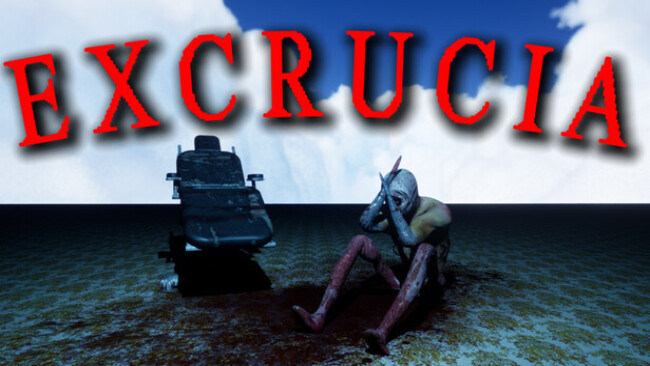
Game Overview
A blood-soaked maze becomes the stage for a deeply personal psychological horror story about guilt, identity, and the fear of being seen by something that calls you “Dad.” Excrucia favors uneasy introspection over straightforward monster hunting, placing players in a purgatorial space where supernatural events may be real, imagined, or inseparable from a damaged mind. Its tone is oppressive and mournful, using twisted affection, religious uncertainty, and graphic imagery to create dread that feels as emotional as it is visceral. Rather than offering easy answers, the narrative repeatedly asks whether a person can be forgiven—or even understand what they have done.
Progress comes through navigating unsettling environments, absorbing story revelations, and making decisions that influence the protagonist’s ultimate fate. Encounters incorporate an unusual rock-paper-scissors-inspired minigame, but it is not simply a matter of blind luck: reading intent, managing risk, and considering the psychological pressure behind each choice add tension to confrontations. The central loop is less about mechanical mastery than surviving uncertainty, piecing together what the world means, and deciding how to respond when perception itself is unreliable. Players who pay attention to dialogue, symbolism, and their own choices have reason to revisit the game, as Excrucia includes two standard conclusions alongside a hidden ending.
What separates Excrucia from more conventional indie horror is its willingness to make its disturbing imagery serve a story about fractured self-image and possible redemption. The maze setting gives it a claustrophobic, nightmare-logic structure, while the choice-driven storytelling keeps players questioning whether they are confronting a monster, a memory, or their own conscience. Its rock-paper-scissors mechanic also provides a deliberately simple framework for moments that would otherwise play like familiar horror-game encounters. Fans of narrative-first psychological horror in the vein of Silent Hill’s more introspective moments should find its themes compelling, while newcomers should expect a short, intense experience focused on discomfort and interpretation rather than action.
Screenshots
Installation
- Select the Download button at the top of this page to open UploadHaven.
- On UploadHaven, wait for any countdown, then select Free Download. Optional: UploadHaven Pro for faster downloads.
- When complete, extract the archive to a Excrucia folder using 7-Zip.
- Open the extracted folder and start the game normally.
- For errors, check Setup Guide & Troubleshooting below. Keep your security software enabled.
System Requirements
- OS *: windows 7
- Processor: AMD Ryzen 5 3600 or I7 Equivalent
- Memory: 8 GB RAM
- Graphics: NVIDIA 960 GTX/AMD RX 570
- Storage: 2 GB available space
Setup Guide & Troubleshooting
How do I fix missing DLL errors for Excrucia?
After extracting Excrucia, navigate to the _Redist or _CommonRedist folder inside the game directory and install DirectX, Vcredist, and any other dependencies included.
What should I do if the downloaded file is corrupted?
The full archive is 0.96 GB — make sure your download completed fully before extracting. Use 7-Zip to extract the files. If you still see a "file corrupted" error, re-download and try again.
Do I need to run the game as administrator?
Usually, no. Start the game normally from the extracted folder. If you see a permissions or save error, check that the folder is writable and follow the game's documented fix. Only grant administrator access when a trusted game's specific setup requires it.
How do I update my GPU drivers for this game?
The game won't launch — what should I try?
Check that extraction completed and your PC meets the system requirements. Note any error message before choosing a fix. If it identifies a missing runtime, install the required DirectX components or Microsoft Visual C++ Redistributable from Microsoft.
My antivirus is blocking the game — is it safe?
A warning needs to be investigated; the download source alone cannot confirm that a file is safe. Keep your security software enabled and review the detection details. Do not run or restore a flagged file unless you have verified that it is a false positive. If you are unsure, leave it quarantined.